
Parish news
“Dilexi te” — A Reflection on the Love That Serves by Pope Leo
October 9, 2025
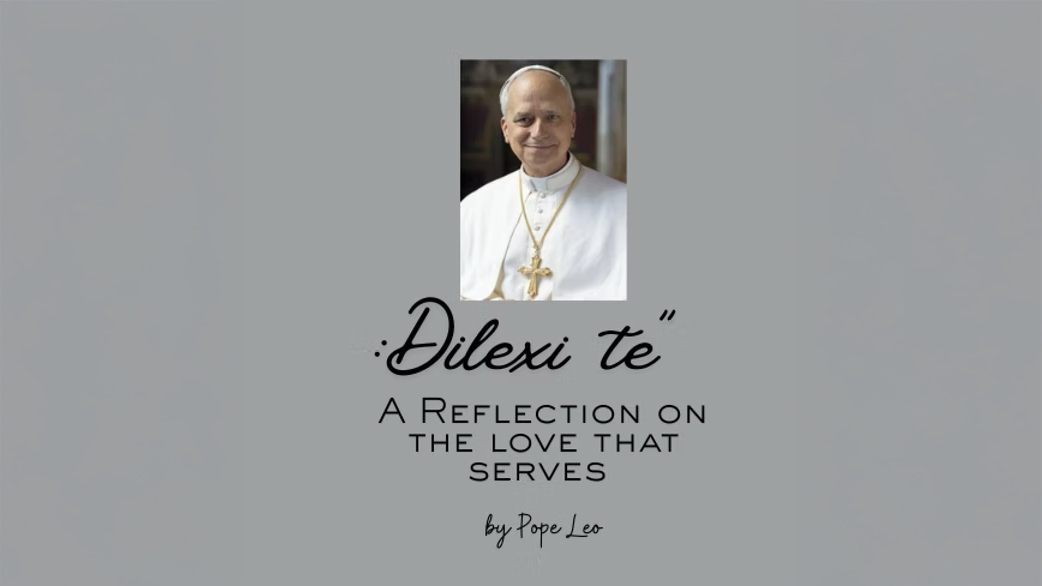
When Pope Leo XIV released his first Apostolic Exhortation, Dilexi te (“I have loved you,” Rev 3:9), he did more than issue a social statement. He offered the Church a meditation on love made flesh — a love that stoops, heals, and restores. Signed on the feast of St Francis of Assisi (October 4th) the document situates itself within the Franciscan spirit of joyful poverty and within the long line of Catholic social teaching that sees the face of Christ in the poor. At its heart lies a conviction as old as the Gospel itself: to love Christ is to love the poor.
From the very first pages, the Pope speaks not as a theorist but as a pastor who has seen human need close at hand. His exhortation flows from the mystery of the Incarnation: the Son of God became poor for our sake so that His followers might discover Him among the poor. Love, if it remains abstract, has not yet been born. It must take on flesh in care for the sick, in defense of the oppressed, in hospitality to migrants, and in the simple gesture of sharing bread with those who hunger. Dilexi te is a call to recover that incarnate tenderness as the true measure of discipleship.
Pope Leo XIV consciously writes in continuity with his predecessors. He recalls St John XXIII’s Mater et Magistra, St Paul VI’s Populorum progressio, and St John Paul II’s deepening of the Church’s “preferential option for the poor.” He draws upon Benedict XVI’s Caritas in veritate, which exposed the moral crises of globalization, and upon Francis’ prophetic insistence that care for the poor and the earth are inseparable. Like Francis finishing Benedict’s Lumen Fidei, Leo takes up the thread of Dilexit nos, Pope Francis’ final encyclical on the Sacred Heart, and shows that the Heart of Christ beats most visibly where the poor are loved and defended.
The poor, he writes, are not a category but a revelation. “On the wounded faces of the poor, we see the suffering of the innocent and therefore the suffering of Christ Himself.” In that single line the Pope condenses the theology of the Cross. God continues to speak through the poor; to ignore them is to become deaf to the Word. Poverty wears many faces — the hunger of those without resources, the humiliation of the marginalized, the silent despair of those stripped of rights or dignity, the moral and spiritual poverty that afflicts even the wealthy. Modern life has multiplied these forms of deprivation, and the Pope insists that Christian charity must widen its gaze accordingly.
For all society’s talk of progress, Leo warns that commitment to the poor remains inadequate. Inequality still grows, and “inequality is the root of social ills.” His words echo the prophets as much as economists: systems that enrich a few while discarding the many cannot claim legitimacy. The Pope challenges the modern narrative that poverty is being steadily eliminated, calling such optimism a deception built on outdated measurements and selective data. True poverty, he insists, is not only material want but also exclusion, loss of meaning, and the erosion of community.
This critique leads to one of Dilexi te’s most searing phrases — “the dictatorship of an economy that kills.” Behind this vivid image lies the conviction that an economy detached from ethics becomes idolatrous. Markets, when absolutized, treat people as expendable. The Pope condemns the “throwaway culture” that tolerates hunger and homelessness as inevitable side effects of prosperity, and he dismantles the idea that unrestricted markets will automatically solve social problems. The illusion of limitless growth, he warns, blinds us to the truth that wealth without solidarity is barren. Conversion must begin with a “change of mentality,” freeing the heart from the illusion that comfort and consumption can bring happiness. “The dignity of every human person must be respected today, not tomorrow.”
Among the most poignant sections of the exhortation are those devoted to migration. The Pope evokes the haunting image of Alan Kurdi, the Syrian child whose lifeless body on a beach briefly awakened the world’s conscience in 2015. He laments how quickly such tragedies are forgotten, how readily societies build walls instead of bridges. The Church, he says, “like a mother, accompanies those who are walking. Where the world sees threats, she sees children.” In every migrant who knocks, Christ Himself is seeking welcome. The Church’s mission, he reminds us, is credible only when it takes the form of closeness and hospitality. Echoing Francis’ four verbs — welcome, protect, promote, integrate — Leo describes the migrant not as a burden but as a gift that purifies the Church’s love.
The Pope extends this same compassion to women who suffer “double poverty” — first from material deprivation, then from discrimination and violence. Their plight, he writes, reveals the hypocrisy of societies that proclaim equality while denying it in practice. Defending the dignity of women, ensuring their safety and participation, is for Leo not an optional social issue but a test of faithfulness to the Gospel that exalts the lowly.
Moving from the faces of the poor to the roots of poverty, Dilexi te rejects the notion that the poor are poor by choice or by fate. “The poor are not there by chance,” the Pope insists. To claim otherwise is to mask cruelty as realism. Most of the world’s poor labor tirelessly yet remain trapped in conditions they did not create. The false meritocracy that equates success with moral worth blinds the prosperous to their dependence on unjust systems. Even believers, Leo notes, can adopt such attitudes, excusing inaction with pious words: We will pray, we will teach doctrine; others will take care of social issues. Against this, he reminds the faithful that prayer and justice are inseparable — the hands lifted to God must also reach toward the neighbor.
In a world that prizes efficiency and despises small gestures, Pope Leo offers a gentle defense of an ancient practice: almsgiving. Charity, he says, is often dismissed as naïve, yet it remains “the burning heart of the Church’s mission.” Almsgiving will not end world poverty, but it will “touch and soften our hardened hearts.” It is not simply aid but encounter — the moment when giver and receiver meet as equals before God. Through such contact the Church preserves her humanity and her joy. Communities that speak about social justice yet neglect actual service, Leo warns, risk spiritual sterility: “They will easily drift into a spiritual worldliness camouflaged by religious practices, unproductive meetings, and empty talk.”
To rekindle this living charity, the Pope turns to the saints. His pages read like a litany of mercy: Francis embracing the leper, Lawrence showing the poor as the Church’s treasure, Ambrose and Chrysostom preaching generosity, Augustine declaring that one cannot love God and ignore the needy. He recalls the Camillians tending the sick, the Benedictines sheltering pilgrims, the Trinitarians ransoming captives, the women’s congregations nursing the abandoned. Their legacy, he says, continues wherever Christians confront “modern forms of slavery” — human trafficking, forced labor, and addiction. “Christian charity is liberating when it becomes incarnate.”
Education, too, belongs to this incarnate charity. Inspired by St Joseph Calasanz, the founder of Europe’s first free public school, the Pope insists that educating the poor “is not a favor but a duty.” Every child has a right to knowledge as a condition of dignity. Education is both justice and evangelization: it frees, heals, and equips persons to participate in society as agents of their own destiny.
Leo XIV also honors the voice of popular movements that resist “the empire of money.” Often treated with suspicion, these movements, he says, embody the cry of the poor for participation and dignity. They challenge the Church to work with the poor, not merely for them. Every Christian, regardless of position, has the duty to “make their voice heard” against unjust structures, even at the risk of ridicule. Structural sin, the Pope reminds us, yields only to the persistent force of good — to minds and systems converted by love.
As the document draws to a close, its tone becomes almost contemplative. “It is evident,” Pope Leo writes, “that all of us must let ourselves be evangelized by the poor.” The poor are not a problem to be solved but a sacrament to be received. They belong to the Church not as beneficiaries but as family. To be near them is to touch the wounds of Christ; to serve them is to enter the mystery of divine mercy. A Church that keeps the poor at her heart remains young, credible, and beautiful.
What makes Dilexi te remarkable is its union of tenderness and clarity. The Pope speaks with moral firmness yet never departs from the language of love. His appeal is not for ideology but for conversion — from comfort to compassion, from indifference to solidarity, from privilege to service. The world he envisions is not utopian but profoundly human: a community where wealth is shared, where migrants are welcomed, where women are safe, where children learn, and where faith expresses itself in concrete love.
The title itself, “I have loved you,” frames the entire exhortation as dialogue between Christ and His Church. First comes His declaration — “I have loved you” — and then the disciple’s response, “I will love in return.” Love begets love. The measure of that response, Pope Leo teaches, is found not in emotion but in action, in the daily works of mercy that make the Gospel credible.
Thus Dilexi te is more than a social text; it is a spiritual exercise. To read it prayerfully is to hear Christ repeating His question to Peter: “Do you love me?” — and to understand that the answer must be lived among the poor, the migrant, the sick, the forgotten. When the Church bends down to serve them, she stands tallest. In those moments, the world glimpses the radiance of a love that truly has no measure — the love that first said, and still says, “I have loved you.”